Client compatibility
franka-sim has no client library. It has a socket. Anything that speaks libfranka's wire protocol works — the sim does not know or care what is on the other end, and there is no franka-sim-specific API to port your code to.
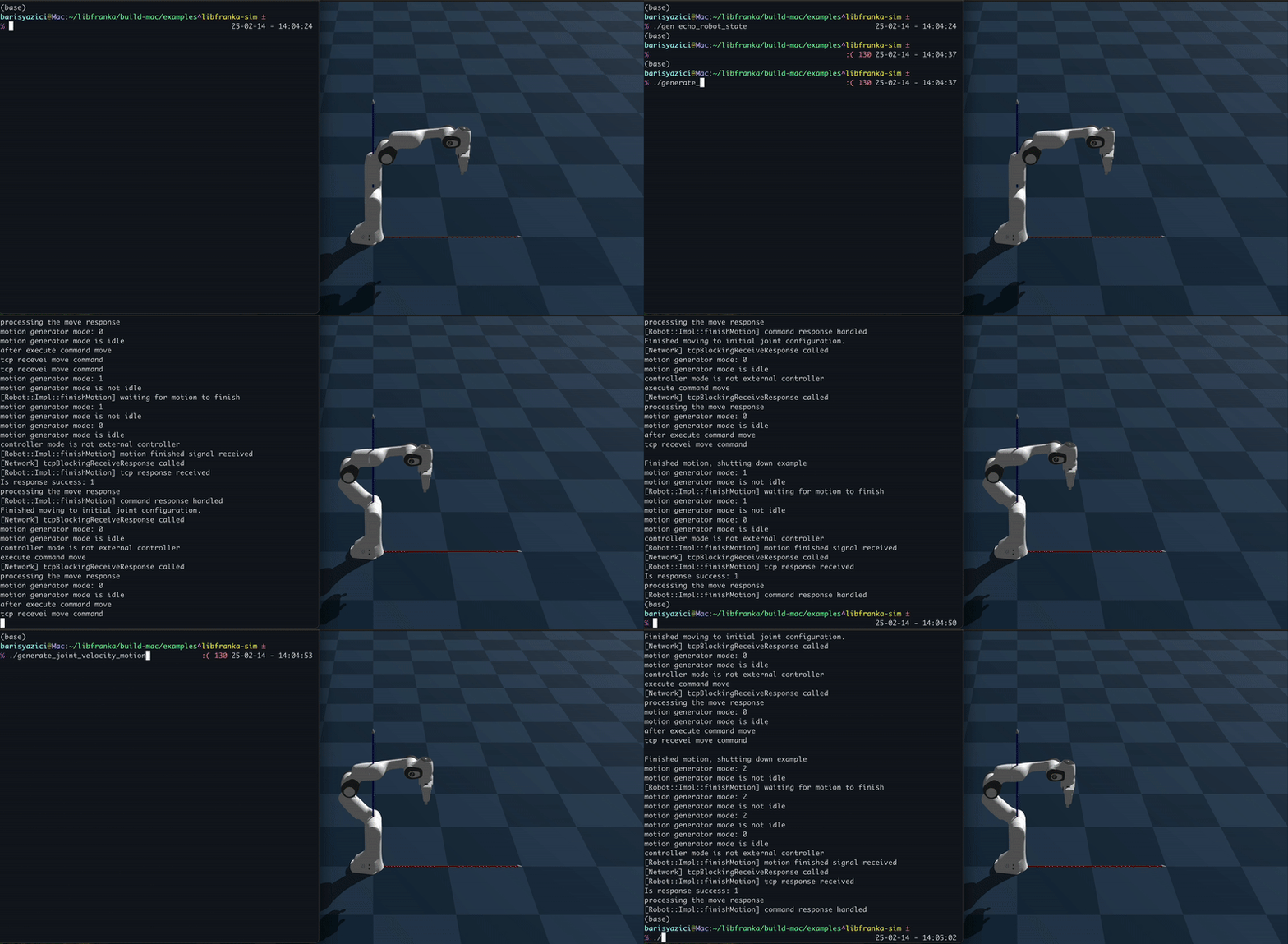
Unmodified libfranka client code driving the simulated arm.
Protocol version
franka-sim implements robot server version 10 and gripper server version 3 — the current libfranka wire format.
| libfranka | Robot system | Robot / gripper server | franka-sim |
|---|---|---|---|
| >= 0.18.0 | >= 5.9.0 | 10 / 3 | supported |
| >= 0.15.0 | >= 5.7.2 | 9 / 3 | not supported |
Protocol 9 and below are a genuinely different wire format — a double-based
RobotState and a server-side LoadModelLibrary instead of GetRobotModel — not
a subset. There is no compatibility shim. See the
Franka software compatibility matrix
for how libfranka releases map to robot system versions.
The model is built client-side in v10
During connection the client calls GetRobotModel, receives a URDF, and builds
its own Pinocchio model from it. franka-sim serves the bundled hand-less FR3
URDF (override with --urdf). Nothing about the dynamics model comes from the
server — which is why a client's franka::Model behaves identically against
sim and hardware.
Verified clients
Official libfranka (C++) — verified
tests/test_real_client_integration.py compiles a real v10 client probe against a
prebuilt libfranka, links it with Eigen, and runs it against a live
FrankaSimServer. It asserts the whole wire contract end to end: Connect, the
exact 1377-byte packed RobotState layout, and a GetRobotModel URDF that the
real client's Pinocchio loader can actually build from.
examples/communication_test from a libfranka build tree runs against the sim
unmodified:
The test skips without a libfranka build
The real-client tests are skipped unless a prebuilt libfranka, g++ and
/usr/include/eigen3 are present, so they do not run in every CI job — only
where the library is available.
franka_ros2 — verified end to end (torque/effort path)
The full franka_ros2 stack runs against the sim FCI: franka_hardware activates,
the gripper action server homes and moves, and
joint_impedance_example_controller drives the arm through ros2_control at
1 kHz (re-verified live against the current protocol implementation).
Scope of that verification: torque/effort controllers. franka_hardware's
torque path reads only measured q/dq and writes tau_J_d, so the sim's
frozen torque-session q_d (see the state reference) is
irrelevant to it. The joint-position and joint-velocity command paths do
consume q_d/dq_d/ddq_d when their default-off rate limiters are enabled;
those combinations have not been re-verified.
Getting there required one thing the sim now implements specifically for this
stack: the AutomaticErrorRecovery handshake. franka_hardware issues it
during activation and stalls forever if the robot never answers. franka-sim
handles it as a protocol-level state transition (robot_mode → kIdle, reply
kSuccess), which is enough to unblock activation.
The reply is not instant: it waits (up to 0.7 s) for the arm to actually stop
moving before answering, the way real recovery does — see
AutomaticErrorRecovery in the state
reference. That is well inside libfranka's own 1 s TCP receive timeout on the
response, so it does not change anything about this handshake beyond making
its timing closer to the real robot's.
Point the hardware config at the sim and nothing else changes:
A ROS 2 build-environment gotcha, not a sim one
A stale hardware_interface overlay (4.40.0 built against a 4.44.0 system) can
segfault franka_hardware in on_init, which looks exactly like a sim
failure. Rebuild the franka packages cleanly before blaming the simulator.
Python bindings — expected to work, not officially verified
libfranka-python, panda-py
and other libfranka wrappers all sit on top of libfranka: they link the same
library and emit the same bytes. There is nothing between them and the sim that
could differ, so they are expected to work — provided the wrapper links a libfranka
= 0.18.0.
Being precise about the evidence: officially verified is libfranka C++ and franka_ros2. Python bindings are strongly expected to work by construction, but franka-sim's test suite does not exercise them.
Your own driver
If you implement protocol v10 yourself, franka-sim is a perfectly good target to develop against — it is easier to instrument than a real arm, and the fidelity reference tells you exactly which state fields carry real information.
The startMotion() handshake
Worth knowing because it is where non-libfranka clients most often stall:
- Client sends
Moveover TCP; server respondskMotionStarted. - Client loops receiving UDP
RobotState, checkingmotion_generator_modeandcontroller_modeagainst what it requested. - When both match,
startJointVelocityControl()(or its siblings) returns. - Only then does the client start sending real UDP commands.
franka-sim drives that sequence from its state-broadcast loop, so the modes flip on
the first state tick after Move.
Lazy clients and the command cycle
franka-sim now measures whether your client actually keeps up. Every published
RobotState opens a cycle, and the sim expects a RobotCommand echoing that
state's message_id back before the next state goes out — precisely what
libfranka's own control loop sends. The window is the robot's "<1 ms constraint"
(libfranka docs/network_requirements.rst): a cycle is not closed before 1 ms
has passed since its state went out, even when the sim's own publish loop is
running late, so the sim's jitter never reads as your packet loss. Cycles that
go unanswered are counted, the last command is held through them, and the
damage is reported in
control_command_success_rate (see
communication constraints).
Two consequences for client authors:
- A client that does not echo the state's
message_id— a hand-rolled driver that stamps its own counter, say — reads as 100% packet loss. It still drives the robot, and by default nothing stops it, but the reported success rate is honest about it. On real hardware such a client would be dropped outright. An id the server never published counts as loss too, in case the counter is not merely stale but invented — and a client running permanently one cycle behind is charged for every one of them, which is the point. - A client that pauses mid-motion sees the success rate fall, and, if the sim
was started with
--enforce-comm-constraints, gets the realcommunication_constraints_violationafter 20 consecutive lost cycles: the pendingMoveis answeredkReflexAborted, libfranka raises aControlException, and the client must callautomaticErrorRecovery()before moving again — aMovesent before that recovery is refused withkCommandNotPossibleRejected, exactly as the robot refuses it.
Enforcement is off by default — a simulator is routinely driven by scripts and teleop bridges that are not 1 kHz realtime loops — so no existing client changes behaviour until you ask for it. Turn it on when you want the sim to reject the timing habits hardware would reject:
Both strictness switches read an environment variable as well
(FRANKA_SIM_ENFORCE_COMM_CONSTRAINTS, FRANKA_SIM_ENFORCE_MOTION_LIMITS), and
both have an explicit off switch — --no-enforce-comm-constraints,
--no-enforce-motion-limits — for a run inside a shell, launch file or container
that exports one.
A missed cycle is extrapolated here, as it is on the robot
The FCI continues the motion signal under constant acceleration through a
dropped cycle, and so does franka-sim: one substitute waypoint per missed
cycle, at the acceleration frozen when the gap began, dispatched to physics
and published back in q_d/dq_d/ddq_d. Your commanded target keeps
advancing during a gap here exactly as it would on hardware, and it stops at
twenty consecutive misses exactly where the robot stops. Always on, whether
or not either strictness switch is.
This matters for more than fidelity. The extrapolated segment ends up
inside Control's finite-difference history, so resuming after packet loss
is differenced against a value Control invented — which is enough to trip
joint_motion_generator_velocity_discontinuity on a client whose own
trajectory is perfectly smooth, and which is what happens if you resume from
the last waypoint you sent rather than from the q_d the robot reports.
A controller that hits that on the robot now hits it here first. See
the real-robot trap you can now reproduce.
The one half that does not extrapolate is torque, and that is also hardware's behaviour: "if a controller command packet is dropped, FCI will reuse the torques of the last successful received packet".
control_command_success_rate is 0.0 when idle
Not a bug and not a stub: libfranka documents the field as showing "a value of
zero if no control or motion generator loop is currently running". echo_robot_state
against the sim prints 0 for the same reason it does against a real robot.
Discontinuous commands
The second strictness switch, independent of the first. franka-sim differentiates
every commanded signal with backward Euler at the 1 ms cycle and compares the
result against the limits libfranka publishes in rate_limiting.h — joint range,
velocity, acceleration, jerk, torque range and torque rate (see
motion limits for the full
table and the error each one latches). Only the signal belonging to the motion's
active generator is judged, so a Cartesian motion is never blamed for the
zero-filled q_c its datagram happens to carry — and, symmetrically, a joint
motion is never blamed for the zero-filled O_T_EE_c its datagram carries, which
is not a valid transform at all.
The checking layer is independent of whether the backend can drive the interface: it judges the stream the client sent, so it behaves identically on a backend that moves the arm from a Cartesian command and one that does not (see Cartesian control). The point of the checks is the abort, which is what lets a client provoking a Cartesian error terminate. With enforcement off they only log, and a client waiting for an abort will still wait forever.
Two things about the error names are worth knowing before you match on them, because both cost people time on real hardware:
- The discontinuity name follows the interface, not the derivative. A step in
q_cisjoint_motion_generator_velocity_discontinuity; the same step indq_cisjoint_motion_generator_acceleration_discontinuity; a twist step iscartesian_motion_generator_acceleration_discontinuity. A step also breaks the velocity envelope, and the discontinuity wins —..._velocity_limits_violationis for a signal that is smoothly too fast, not for one that jumps. joint_velocity_violationis notjoint_motion_generator_velocity_limits_violation. The first is the safety controller watching measured velocity and fires in every mode, torque included; the second is Control judging your command. When the second trips during a motion, the sim now latches both — not a pin this project verified directly, but hardware is reported to raise the same pair, so match on either name and expect to see both in theControlException. See the safety controller.
Checking and reporting are always on: a violation logs a rate-limited warning naming the joint or axis, the value and the limit. Aborting is opt-in:
With it on, a command the robot would refuse never reaches the physics, the
matching error is latched, the pending Move is answered kReflexAborted, and the
client must call automaticErrorRecovery() before moving again — the same shape as
a communication violation, with a different bit.
Five things worth knowing before you turn it on:
- A stepped target is now an error, not a teleport. Scripts that jump
q_cstraight to a goal work fine by default and abort under enforcement. That is the point: on hardware they would have aborted too. q_c = 0is not a valid FR3 pose. Joint 4 lives in[-3.0481, -0.1458]and joint 6 in[0.5409, 4.5205], so an all-zeros command is ajoint_motion_generator_position_limits_violationon the real robot as much as here. Test fixtures that stream zeros are the most common thing this catches.- A non-finite command is refused either way. NaN and ±∞ in
q_c,dq_c,tau_J_dorO_dP_EE_care dropped with a warning whether or not enforcement is on, because every limit comparison against a NaN is false and applying one poisons the state, the difference history and the wire. libfranka refuses to send one at all, so this only ever fires for a hand-rolled client. - A late datagram is checked, not waved through. A command whose echoed
message_iddoes not answer the cycle it arrived in is still applied, and it is differenced over the interval the server observed between it and the last applied command — never over a wider one than the server has actually published. A hand-rolled client that stamps ids ahead of anything it was sent gets no discount on the limits: the interval is bounded by the server's own count, so inflating the echo buys nothing. -
A burst of late datagrams no longer aborts a conforming client. Two separate causes, both gone:
The differencing window used to be capped at three cycles (
MAX_COALESCED_CYCLES) and taken from the client's echo, so four back-to-back lost datagrams made the sim judge the resumed command over less time than it really took and trip a discontinuity for a client that never left its own envelope. The window now comes from the server's own observation (MotionLimitChecker.note_published), so a burst is measured at the rate the client actually commanded. The cap survives only as a fallback for callers that drive the checker without a publish loop.And a receive thread that was descheduled hands over a whole backlog of real datagrams at once. Each of them is the true answer to a cycle the publish loop had already extrapolated, and each has its guess thrown away (
MotionLimitChecker.absorb_command) — for the whole run of losses, not just for the first one of it, and as one indivisible step so the publish thread cannot land in the middle of it. Stalls of 1 to 11 cycles are pinned to resume clean; before, they reported 127 rad/s² and up, linear in the stall.This is about datagrams that arrive late. A client that genuinely goes quiet and then resumes from its own last waypoint is a different thing, and it still aborts — deliberately; see the resume trap below. * A host stall long enough to freeze the whole process can still trip a discontinuity — but now for the same reason it would on hardware. libfranka closes its own low-pass filter around
q_d—ControlLoop::convertMotionfilters every waypoint towardrobot_state.q_dwith a fixed 1 ms gain — so a reference that goes anywhere the client does not expect drags the client's own commanded stream with it. A frozen one used to be the sim's own doing; that is gone, because a missed cycle now extrapolates and the publishedq_dkeeps advancing along the trajectory (above). What remains is the genuine article: if the stall is long enough that the extrapolated reference and the client's resumed stream have parted company, the difference between them is a real discontinuity and hardware would report it too. Everything else the sim can control here is fixed: the publish loop no longer emits two states microseconds apart after an overrun, it no longer runs ahead of its own receive path, and it no longer closes a cycle before the client's 1 ms window to answer it is up.
Cartesian control
Both Cartesian motion generators drive the arm on the default MuJoCo single-arm
backend. kCartesianPosition streams O_T_EE_c, kCartesianVelocity streams
O_dP_EE_c, and either becomes joint motion through damped-least-squares
differential IK (franka_sim/cartesian_ik.py) on the MuJoCo Jacobian at the
EE frame — the frame F_T_EE defines, so a tool set with setEE really is the
point that is being commanded. The joint velocity that comes out goes into the
same velocity servo a kJointVelocity motion drives, which is what makes the
measured-side safety checks apply unchanged: an over-fast Cartesian command
reaches the joint velocity envelope and aborts with joint_velocity_violation
exactly as it does on hardware.
Details worth knowing:
- The checking layer is unchanged — and now has a joint side. IK tracking
is a second consumer of the accepted command stream, not a filter on it.
Every limit check listed under discontinuous commands
runs first and on the same signal it always did; in addition, the commanded
pose is solved to joint space every cycle and the resulting joint velocity and
acceleration steps are held to the robot's per-joint limits, which is what
raises
cartesian_motion_generator_joint_velocity_discontinuity(29) /..._joint_acceleration_discontinuity(30) on a real Franka for a Cartesian ramp that is well inside the Cartesian limits. The limits are the simulated robot's: the FER's per-joint tables under FCI v5 (calibrated on a Panda), the FR3's published 10 rad/s² / 5000 rad/s³ under v10 (not yet confirmed against an FR3); tunable with--joint-discontinuity-scale; see the joint side. - The elbow steers the null space.
elbow_c[0]is the redundancy angle (joint 3 on an FR3) and is chased inside the Jacobian's null space, so it moves the elbow without moving the end effector.elbow_c[1], the branch flag, is not followed: flipping it means passing through a singularity, which the FCI treats as an error rather than a command. - A Cartesian
Moveis refused from a singular configuration, withMove::Status::kStartAtSingularPoseRejected— libfranka's "Move command rejected: cannot start at singular pose!". The test is the smallest singular value of the EE Jacobian at the arm's measuredqagainst a threshold of 0.05; seeSINGULAR_POSE_MIN_SINGULAR_VALUEfor how that number was placed. Joint interfaces are not refused — driving out of a singularity is the only way to leave one. - Under
kExternalControllernothing changes. There the client's torques drive the arm and the Cartesian stream is a reference, so the sim stays in torque mode exactly as before. - The controller mode is not a control law here. Both internal controllers —
kJointImpedanceandkCartesianImpedance— drive the arm through the same joint-velocity servo, because that is the only law the backends implement.SetCartesianImpedance'sK_xis accepted and not enforced, so a client that pickskCartesianImpedanceto get a compliant end effector gets a stiff one that tracks its commands instead. What it will not get is silence: naming onlykJointImpedanceon the dispatch path would leave akCartesianImpedanceCartesian motion accepted, checked and completely inert. O_T_EEis measured atlink7, not at the true flange (link8, 0.107 m further along z). That is a pre-existing frame choice shared with the Genesis backend and the mobile-duo scene, andF_T_EEis composed on top of it — so the sim is self-consistent, but an absolute Cartesian target taken from a real robot lands 0.107 m away from where hardware would put it.- Not on every backend. Genesis and the mobile-duo scene view implement no IK; there the Cartesian interfaces stay checked-but-inert.
Multiple robots on one host
libfranka pins the command port to 1337 and gives you no way to change it, so you
cannot run two robots on one address. The fix is one loopback address per robot
— 127.0.0.0/8 is entirely loopback on Linux, so any 127.x.y.z works and no
interface aliasing tricks are needed beyond adding the address:
Then bind one bridge per address:
run-franka-sim-server --mobile-duo \
  --bind left=127.0.0.11 --bind right=127.0.0.12 --bind base=127.0.0.10 \
  --scene-urdf ... --mesh-root ...
and construct one client per address:
This is exactly how the mobile duo serves three robots from one
physics scene, and it works for independent single-arm servers too — start each one
with its own --bind-equivalent address.
What will not work
| libfranka <= 0.17 (protocol 9) | Different RobotState layout. Not supported. |
franka::Robot::setGuidingMode, setEE, setK, setLoad |
The commands are accepted and acknowledged, so your client will not hang — but the values are not enforced by the sim. See TCP commands. |
| Cartesian control on the Genesis backend and the mobile-duo arms | The arm does not move. Those backends implement no differential IK, so kCartesianPosition/kCartesianVelocity get kMotionStarted and the commanded stream is checked but never applied. The default MuJoCo single-arm backend does drive both interfaces — see Cartesian control. |
| Anything relying on contact/collision reporting | The collision and external-force fields are permanent zeros today. See the field table. |
Known issue: run-to-run repeatability of velocity generators
The sim does not reproduce a velocity-commanded motion to the same joint
configuration twice. Two runs of the same kJointVelocity, kCartesianVelocity
or torque motion from the same start pose end tens of milliradians apart under
host load. Position generators are unaffected — they close the loop on a
commanded pose and correct whatever the last cycle got wrong — so this is
specifically the integrating interfaces.
Why. The physics thread paces itself on the wall clock, one 1 ms step per
millisecond of real time. The client's motion profile advances on a different
clock: the message_id of the states this server publishes, which is what
libfranka's Duration counts. Those two clocks are the same clock on hardware
and are not here — the publish loop sits a few Hz under 1 kHz (a deliberate
consequence of the minimum state spacing
that keeps two states from being sent microseconds apart after an overrun), and
it loses more ticks the busier the box is. Every millisecond of slip is one more
physics step of the last commanded velocity than the client's own clock
accounted for, integrated straight into the joint configuration and never
corrected.
What you will see. A client that runs one motion sequence through
robot->control() and then the same sequence through the read/write
active-control interface, and compares where the two land, will see them
diverge. Held to a 5e-3 rad per-joint tolerance, that comparison fails against
the sim roughly 10–30% of the time depending on load, and a long multi-stage
motion sequence occasionally goes with it. This is not new in
the Cartesian release: it reproduces on the release before it, where the
divergence enters at the kJointVelocity stage instead (0.044 rad observed), and an
interleaved A/B of the two revisions does not separate them (4/12 vs 1/12 failures,
Fisher p ≈ 0.32). Driving the Cartesian generators simply gave the same mechanism
two more motions to accumulate in — an 8 s open-loop twist trajectory is the
longest integration involved.
What to do about it. Nothing, if you are running a controller: this is a repeatability property, not a correctness one, and nothing else is affected. If you are diffing two runs of the same trajectory, difference the commanded stream rather than the measured configuration, or drive a position generator. The real fix is to step the physics once per published control cycle instead of once per wall millisecond, so that the robot's clock is the clock the client sees — that is on the roadmap, not in this release.
One residual is not explained. A kCartesianPosition motion very
occasionally aborts mid-flight with
cartesian_motion_generator_velocity_discontinuity at a few hundred to ~1500
m/s² on O_T_EE_c, on a commanded stream that is smooth by construction (~1 in
15 runs of that A/B comparison observed). The commanded pose is echoed from the
client's own stream, so a stale echo would explain it — but that has not been
demonstrated, and the mechanism above does not account for it. Treat an isolated
Cartesian discontinuity abort as possibly the sim rather than your client, and
please report it.