franka-sim
franka-sim is a simulator for the Franka Control Interface that speaks the real
wire protocol. It listens on TCP port 1337 for libfranka's v10 command protocol
and streams RobotState over UDP at 1 kHz, byte-for-byte in the layout libfranka
expects. Unmodified client code — the official C++ examples, franka_ros2, your own
controller — connects to it exactly the way it connects to an FR3, by pointing at a
different IP address.
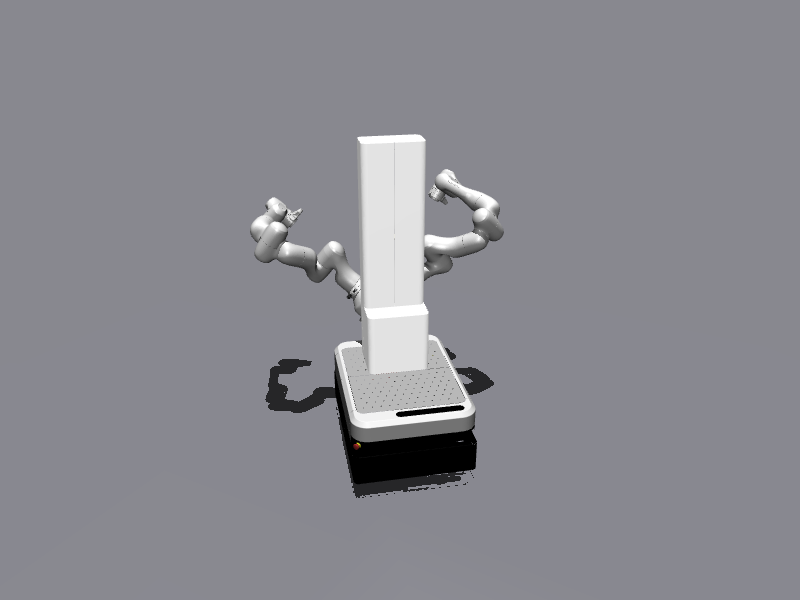
The --mobile-duo scene: two FR3 arms plus a prismatic lift on a TMR swerve base,
one physics scene served by three FCI bridges.
Watch it move →
Why it exists
The usual robot simulator gives you a Python API and asks you to write a second
version of your controller against it. franka-sim gives you a socket. Everything
above the socket — libfranka, franka_hardware, ros2_control, your motion
generator, your 1 kHz torque loop — runs the code that will run on hardware, with
its real timing, its real handshakes and its real state struct.
That makes the sim useful for the things a Python-API simulator cannot check: protocol handshakes, controller activation, timing behaviour under a 1 ms budget, and the sim2real gap in the layer you actually deploy.
What you get
-
The real protocol, not an approximation
libfranka wire protocol v10 (robot server 10 / gripper server 3).
Connect,Move,StopMove,GetRobotModel,AutomaticErrorRecoveryand the setter commands; the 1377-byte packedRobotStatestruct; thestartMotion()mode handshake. Verified against a real libfranka v10 client binary in CI-capable tests. -
MuJoCo at true 1 kHz
The default backend steps at 1 ms — one physics step per FCI control cycle — and holds 1.00x real time on about a third of one core. No sub-sampling, no "close enough" 500 Hz. Genesis is available as an extra for GPU-parallel RL scenes.
-
Single FR3, with or without a hand
A hand-less FR3 arm by default, plus a Franka Hand gripper server on port 1338.
--gripper-physicsloads the hand mesh and simulates the finger DOFs, sohoming/move/graspvisibly move the fingers. -
The mobile FR3 duo
Two arms, a TMR swerve base and a vertical lift in one scene, served by three FCI bridges plus a fake spine REST device. Drop-in for the real mobile rig — same client configs, sim IPs swapped in. See the showcase.
-
Headless-first
The viewer is an opt-in flag (
-v), not the main loop. Everything runs on a server without a display: CI, batch rollouts, remote GPU boxes. -
Honest about its gaps
Some
RobotStatefields are physics-measured, some echo your command, some are constants. The fidelity reference tells you which is which, field by field, with code references — before it bites you.
Quickstart
- Pulls MuJoCo, the default physics backend. The FR3 model itself is fetched from
MuJoCo Menagerie on first run via
robot_descriptions. - Drop
-vto run headless. The FCI listens on127.0.0.1:1337, the gripper on127.0.0.1:1338.
Then point any libfranka client at 127.0.0.1 — no recompile, no shim:
franka::Robot robot("127.0.0.1");
robot.setCollisionBehavior(/* ... */);
robot.control([](const franka::RobotState& state, franka::Duration) {
  // your 1 kHz callback, unchanged
});
Or with the official examples, straight from a libfranka build tree:
libfranka >= 0.18.0 required
franka-sim implements server protocol version 10 only. libfranka 0.15–0.17
speak protocol 9 — a different RobotState layout (double-based) and
server-side LoadModelLibrary instead of GetRobotModel — and will not
connect. See the compatibility matrix.
Where to go next
| If you want to… | Read |
|---|---|
| Install it, and know every CLI flag | Installation |
| Know whether your client will work | Client compatibility |
| Know which state fields are real physics | State & command fidelity |
| Run the two-arm mobile rig, or VR teleop | Mobile FR3 duo |
| Choose between MuJoCo and Genesis | Physics backends |
Architecture
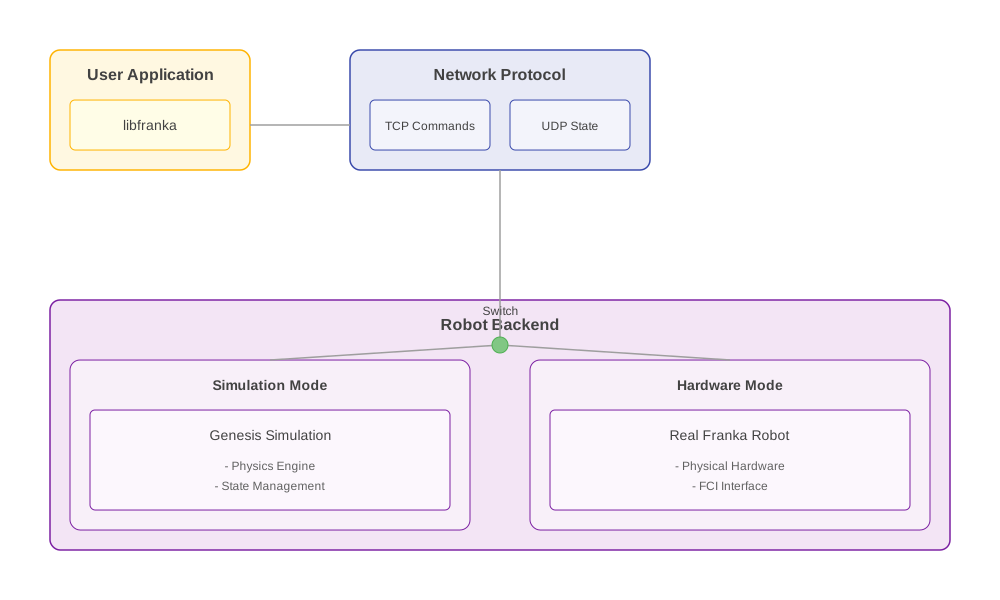
The server is three layers:
- Protocol layer — the TCP command socket (1337) and the UDP state/command
pair. Owns the
RobotStatestruct, theMovehandshake and the control-mode state machine. - Physics layer — MuJoCo (default) or Genesis, behind one interface. The protocol layer calls identical methods on either, so a client cannot tell them apart from the wire.
- Device stubs — the gripper server (port 1338, gripper protocol 3) and, for the mobile duo, the spine REST device.
The robot model is built client-side in protocol v10: during connection the client
fetches a URDF through GetRobotModel and builds its own Pinocchio model, so the
server ships a URDF rather than a compiled model library.