Node parameters protocol
franka-node exposes live Cartesian impedance tuning through JSON over Zenoh. This page
defines the node’s params/* surface; Tune a running controller describes
its use. Motion targets, state and command messages remain separate.
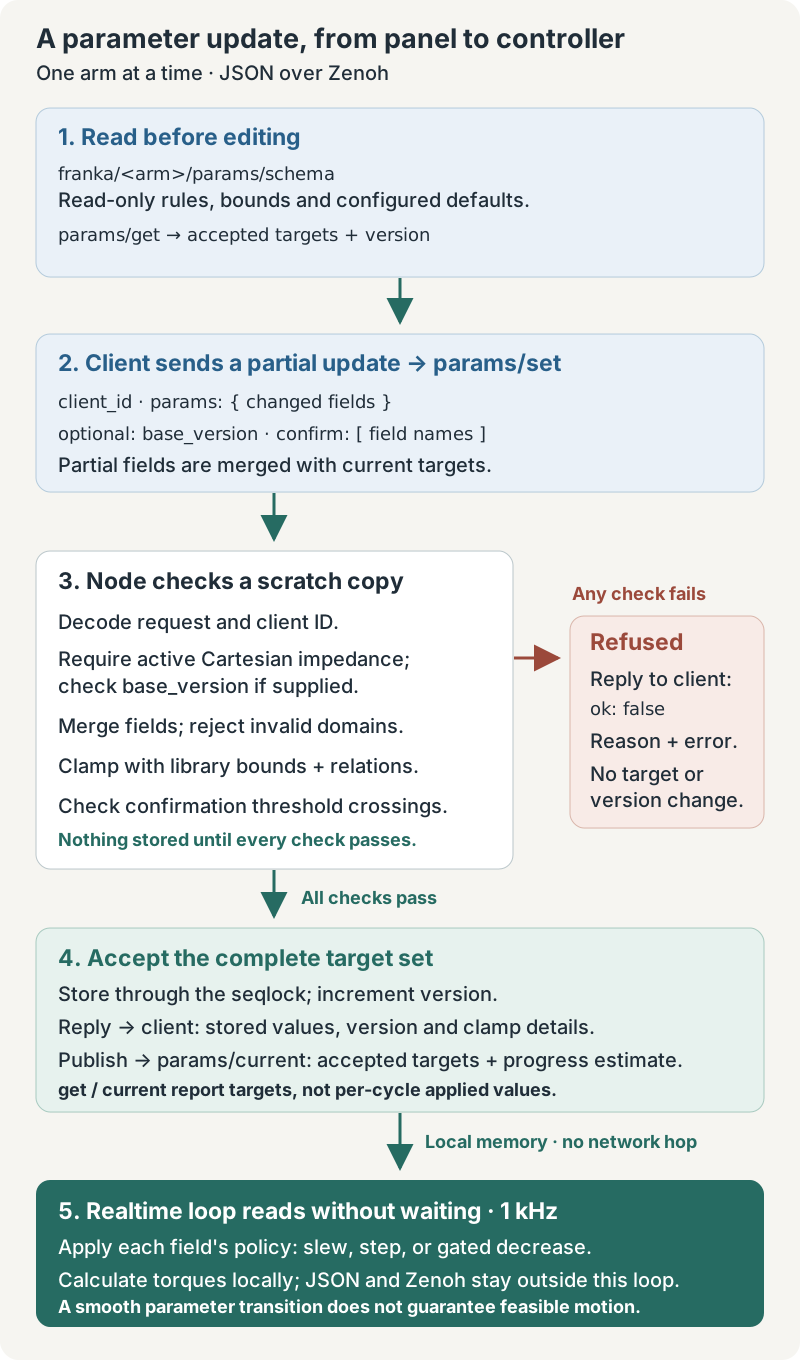
From request to controller
Keys and discovery
| Key | Kind | Payload |
|---|---|---|
franka/<arm>/params/schema | Queryable | No request payload; schema reply. |
franka/<arm>/params/get | Queryable | No request payload; current accepted targets. |
franka/<arm>/params/set | Queryable | Partial update and acceptance/refusal reply. |
franka/<arm>/params/current | Publisher | Same body as get; on accepted updates, session reseeding and approximately every second. |
<arm> is the configured arm name. Wildcard queries such as franka/*/params/schema discover
arms; replies use each concrete arm key. Schema and get work without a running session.
Set requires a live Cartesian impedance session; idle and joint sessions return not_ready.
Tuning uses a positive client_id for attribution, not authorization: it does not check
that the sender owns the motion lease. Bus access must therefore be limited to trusted
operators. One set is atomic for one arm; no transaction spans arms or other parameter owners.
Schema
The envelope contains owner: "node", arm, boot_id, schema_version: 1, params,
relations and derived. Reject unsupported schema versions in a client.
Each params entry describes one field:
| Property | Meaning |
|---|---|
type | Currently f64, f64[3] or f64[7]. |
min, max, default | Scalar or matching-length arrays; defaults are this arm’s configured session baseline. |
unit | Optional scalar string or array of unit strings. |
policy | slew, step or step_up_gate_down; a budget field reports the strongest policy among its elements. |
slew_tau_s | Present for slewed fields. |
group, scale | UI grouping and linear or log display. |
danger | Absent, "advise" or "confirm_above". "advise" marks a field that reaches the torque directly and asks for no confirmation. |
confirm_above | Present exactly with danger: "confirm_above": the threshold, in the field’s scalar/array shape. |
slider_max, off_at, norm | Optional presentation hints; the text entry can still use the full range. norm: true marks a velocity/acceleration/jerk budget, whose per-axis share is the norm divided by √3. |
Ranges and policies come directly from LiveTuning::BOUNDS, the library’s own gate
(Tune the law while it runs);
clients must query them rather than maintain a copy. The nine fields are
joint_stiffness, joint_damping,
cartesian_stiffness, ik_damping, ik_nullspace_gain, velocity_feedforward_gain,
velocity_feedforward_cutoff, budget and rotation_budget (25 scalar values total).
relations contains human-readable {"rule": "..."} entries. Currently the joint damping
floor depends on the corresponding joint stiffness. The node enforces that relation; clients
should show the rule and the accepted values rather than independently interpreting its text.
derived is read-only: leash{translation,rotation}, max_lead, max_lead_rotation,
max_step, max_step_rotation, max_step_joint, rate_hz, state_hz, stop_after_ms,
delta_t, dq_limit[7], cutoff_frequency, and
cartesian_preset{stiffness[6],damping[6],reference}. Joint velocity limits depend on the
connected robot’s FCI version. There is no joint_inertia value or node metrics endpoint.
Get and current
The body contains:
| Property | Meaning |
|---|---|
owner, arm, boot_id | Owner, arm and node-run identity. |
version | Number of accepted sets in this node run. |
t_node_ns | Node-host monotonic timestamp in nanoseconds. |
origin | null after initialization or session reseeding; otherwise {version, by, at_ns} for the last accepted set. by echoes its numeric client_id. |
params | Complete accepted tuning targets, or the TOML-derived baseline without a tunable session. |
slewing | Field name to estimated fraction of the latest accepted change still remaining. |
dirty | Whether accepted targets differ from the loaded configuration’s baseline. |
params does not expose the controller’s per-cycle interpolated values. For slewed fields,
remaining fraction decays with the published time constant. For downward budget ramps it is
estimated from the previous and new targets and elapsed time. Array fields report the largest
remaining fraction; fractions below 0.005 are omitted. Stepped, unchanged or settled fields
are omitted. This is a wall-clock estimate of the latest update, not realtime feedback, and
does not track all overlapping transitions.
Session start/end restores configuration values and clears origin and slewing, while
keeping version. Node restart creates a new boot_id and resets version to zero. A
client should refresh after either a boot change or a reseed; base_version alone cannot
detect session reseeding or a restart that happens to reach the same version again.
The live feedforward gain is seeded as zero when TOML has velocity_feedforward = false, the
default, regardless of velocity_feedforward_gain. There is no separate live boolean field;
its confirm_above is 0, so switching it on live needs a confirmation.
Set request and validation
For example, after fetching the current version:
{
  "client_id": 7,
  "base_version": 2,
  "params": {"ik_damping": 0.1}
}
client_id is a nonzero u32. base_version is optional optimistic concurrency control:
if present, it must match the current version. Optional confirm is an array of field names.
Omitted parameter fields retain their values; an included array must contain every element.
Unknown top-level request properties are rejected; unknown names in confirm are ignored.
The node processes a request in this order:
- Deserialize the envelope and validate
client_id. - Require a tunable session and check
base_version. - Validate field names, number types, lengths and finite values; merge into a scratch copy.
- Reject invalid domains before clamping: notably nonpositive
ik_dampingorcartesian_stiffness. A request for zero is refused, not converted to the minimum. - Clamp requested fields using the library bounds, including the stiffness-dependent damping floor. Increasing a spring may also raise damping that the request omitted.
- Check confirmation crossings against these proposed stored values.
- Store the complete accepted target set, increment version, reply and publish current.
Any refusal leaves the targets and version unchanged. An accepted empty/no-op update still increments the version. Configuration seeds and unchanged fields are not automatically re-clamped by a partial update; schema bounds describe the live update gate.
confirm_above means crossing from at or below the threshold to above it, using current
stored targets and the clamped proposed targets. For arrays, any element crossing requires
the field name in confirm. Already-high values can be increased further or lowered without
another confirmation. danger: "advise" does not require confirmation.
Replies
Accepted replies contain ok: true, the new version, the complete stored params,
clamped and slewing. Each clamp is:
{"field": "joint_damping", "index": 0, "requested": 0.0, "stored": 1.0}
This is the record’s shape, not a recommended gain. index is zero-based for array fields
and null for scalars. If the damping relation changed an omitted field, requested is
that field’s previous value. Always use the reply’s stored values.
Refused replies contain ok: false, reason, field (or null), human-readable error
and the unchanged version. The protocol vocabulary is type, non_finite, length,
unknown_field, relation, needs_confirm, stale, not_ready, busy, invalid.
The current node maps library gate errors to invalid with field: null and the field
named in error; relation and busy are reserved vocabulary rather than promised outcomes.
Malformed JSON, including JSON representations that cannot encode a finite number, can be
rejected as type before field decoding.
The optional HTTP bridge adds its own failures, such as unreachable, aborted,
bad_schema, no_state and stale_state. These are not node parameter refusals.
How the seqlock reaches the control loop
A seqlock is a shared slot with a sequence counter. It lets the realtime loop read a complete set of 25 tuning values while another thread writes, without taking the writer’s mutex. That matters because the controller must not combine new stiffness with an old damping value from a half-finished update.
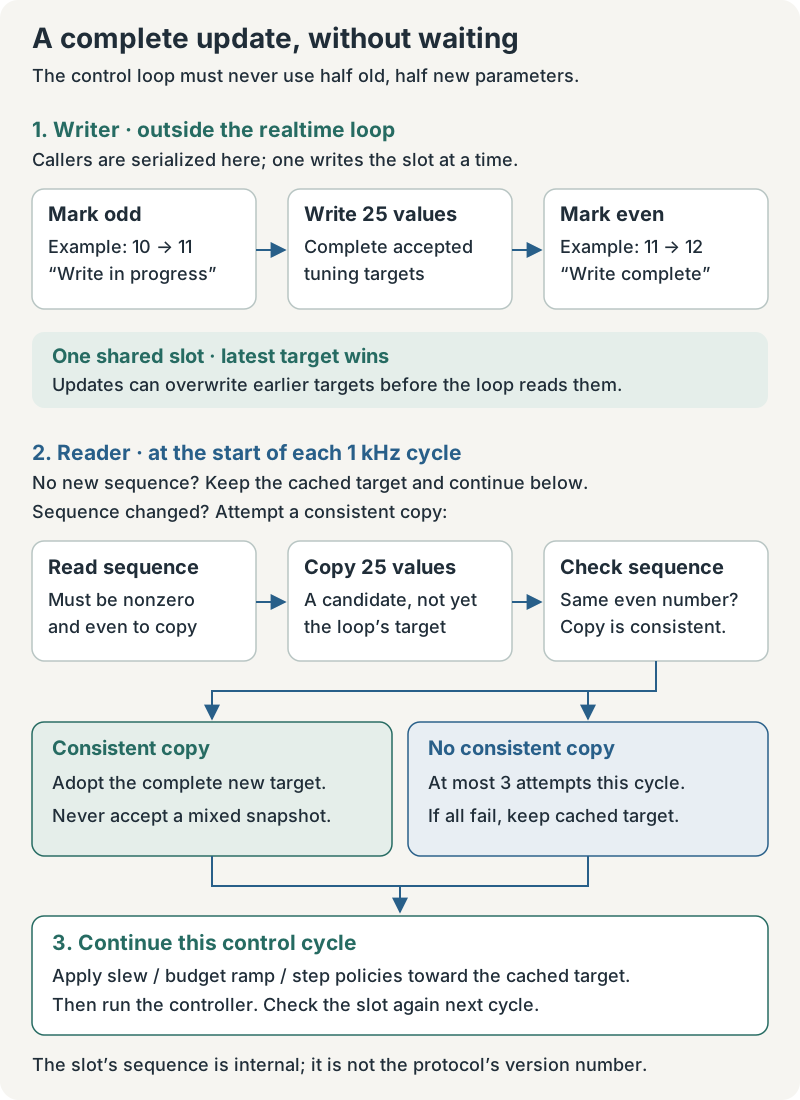
The library serializes writers outside the realtime loop. A writer increments the sequence to an odd number, stores all 25 values, then increments it to an even number. The reader accepts its copy only when the sequence is nonzero, even and unchanged across the copy.
Each control cycle first checks whether the sequence changed. If it did, the reader makes at most three attempts to obtain a consistent snapshot. If all fail, it keeps the previous complete target, continues any transition toward that target, and tries again next cycle. It does not wait for the writer. An unchanged slot costs just the initial sequence check.
This is a latest-value slot, not a queue: several accepted updates between control cycles
can collapse into one observed target. Acceptance therefore does not mean each intermediate
target was applied to the robot. The slot’s internal sequence counter is separate from the
JSON protocol’s version, which counts accepted requests.
Application and persistence
The arm thread validates and publishes tuning through a seqlock slot. The realtime loop reads it without waiting and applies transitions locally; no JSON, Zenoh or panel work runs on that loop. Gains slew with the schema’s time constant. Budget velocity lowers no faster than the acceleration limit, and acceleration lowers no faster than jerk; increases take effect immediately. Jerk and feedforward cutoff step. This bounds parameter transitions, not the feasibility of every requested robot motion.
There is no params/save. Changes last only until the session ends. Edit TOML and restart
the node for a persistent baseline; panel preset storage is separate.
t_node_ns and origin.at_ns use the node host’s CLOCK_MONOTONIC, as does robot state
telemetry. They are not Unix time and are not directly comparable across hosts. State remains
the packed binary StateMsg at configured state_hz; node status is node-scoped JSON at
franka/node/<name>/status. Neither is a per-cycle report of applied tuning. See
Serve arms over Zenoh for those channels.