Serve arms over Zenoh: franka-node
At the end of this page a small machine next to the robots runs franka-node, and a program
on another machine, in any language with a Zenoh binding, takes an arm,
streams pose or joint targets to it and reads its state, without linking franka-rs or
running a realtime kernel itself. The crate is franka-node, under crates/franka-node
in the repository; its README
has the byte-exact wire tables, the verb table and every configuration key. This page is the
guided tour.
Prerequisites: Command from a low-rate program, whose loop the node
runs; a host on the robot network that meets The realtime machine
(a Raspberry Pi 5 with a PREEMPT_RT kernel does); and the simulator or a robot.
What it is
franka-node is one process that owns one or more franka::Robots and, per arm, runs
start_cartesian_target_control or start_joint_target_control with the impedance backend.
Clients publish 80-byte targets at any rate on a Zenoh key; the node gates each one (lease
holder, order, kind, finite values, step from the previous accepted target, joint limits, rate,
and a workspace box if the config names one) and hands it to the library’s generator, which
does the 1 kHz work on the realtime thread the library owns. The arm’s state goes back out at
100 Hz as a fixed-layout message, and acquire, enable, stop, release, recover and
home are request/reply queryables with JSON payloads.
A client holds an arm through a lease: a Zenoh liveliness token it declares while it
lives. The token going away, because the client exited, was killed or lost the link, stops
the arm; so does silence: no accepted target for hold_after_ms (200 ms) flags the state as
holding, no target at all for stop_after_ms (2 s) stops the loop, and the robot’s own
controller holds the arm where it is. A second client is refused while the first holds the lease.
The data path
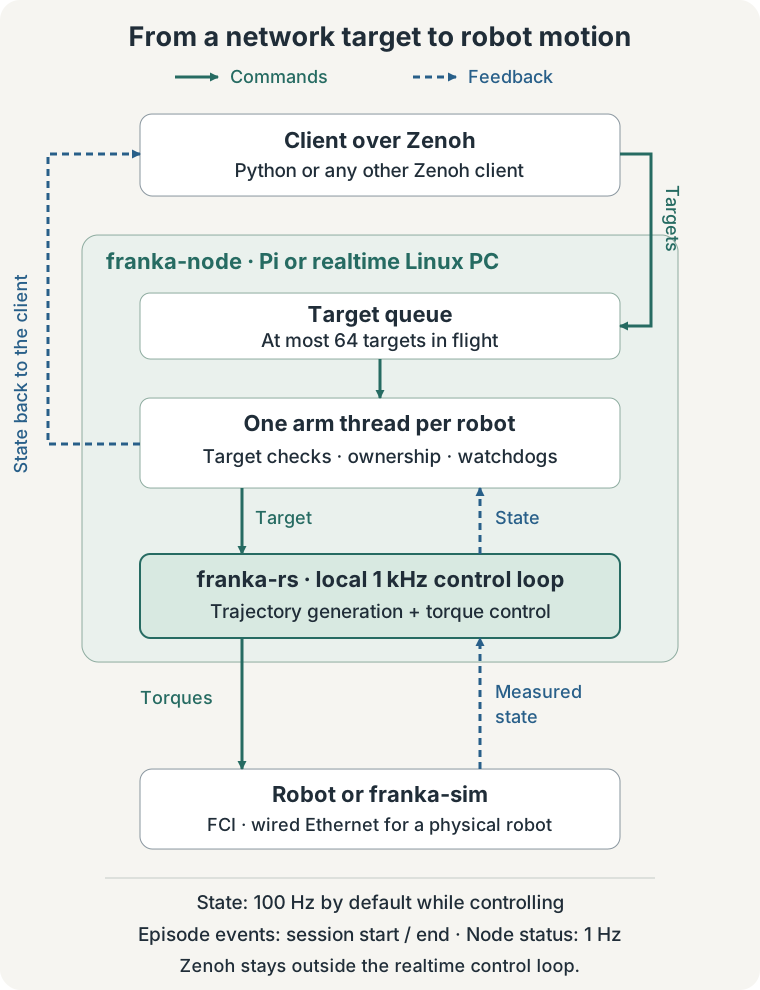
The Zenoh callbacks decode a fixed layout with zerocopy and send without blocking; the arm
thread drains its channel, runs commands and lease events in arrival order and judges only
the newest target of a drain (the rest count as dropped). The realtime loop never sees
Zenoh, the channel or an allocation from the node; the node never sees the robot’s UDP
stream. This is the same design as the library’s own target control, one process boundary
further out.
When to use it, and when the library
Use the node when the commander is not on the realtime machine (a laptop over Wi-Fi, a
workstation running a policy, a notebook), when it is not written in Rust or Python, when
several programs take turns on one arm, or when one small host should serve two arms to the
rest of the lab. Its costs are a network hop per target (the state echoes the accepted
target’s t_send_ns, so a client measures its own round trip; the client example prints
it) and one more process to run.
Use the library directly, target control or the
Python bindings, when the commander runs on the realtime
machine anyway, needs the RobotState at 1 kHz or an observer on the loop, or wants the
robot’s controller (Backend::RobotController), which the node does not offer.
Configuration
One TOML file; every key has a default except an arm’s name and host:
name = "node1"

[zenoh]
listen = ["tcp/0.0.0.0:7447#iface=eth0"]
scouting_interface = "eth0"          # optional; "auto" when absent

[[arm]]
name = "fr3"
host = "172.16.0.2"
realtime = "enforce"                 # or "ignore" without a PREEMPT_RT kernel
collision_force = 40.0               # N; set_collision_behavior_simple(torque, force)
collision_torque = 40.0              # Nm
budget = [0.3, 0.5, 20.0]            # translation limits, a norm: m/s, m/s², m/s³
max_step = 0.05                      # m per target from the previous accepted one
max_lead = 0.05                      # m a target may lead the measured pose; 0 disables
# workspace = { min = [0.2, -0.5, 0.0], max = [0.8, 0.5, 0.8] }   # off unless set
# cpu = 2                            # pin the loop thread to this core (isolcpus)
name is the node’s, in its status key; the arm’s name is the <arm> of every key
(franka/fr3/target, franka/fr3/state, …). A second [[arm]] table is a second arm in
the same process, each with its own thread, loop and, with cpu, core. joint_position_margin
(0.05 rad) is how far the arm’s joint goal keeps from its joint limits, and a joint target inside
it is refused (the guard). The full
key list with the stiffness, leash, deviation and joint keys is in the README and in
crates/franka-node/config.example.toml, which the config tests parse.
Running it
cargo run --release -p franka-node -- node.toml
RUST_LOG=debug cargo run --release -p franka-node -- node.toml    # refusals, with their reasons
Transitions (idle -> acquired (acquired by 7)) are logged at info, refusals at debug.
SIGINT or SIGTERM stops every arm through the library’s settle and exits. Under
realtime = "enforce" the node constructs each robot on a scratch thread, so Robot::new’s
SCHED_FIFO promotion lands nowhere that outlives it: the node’s own threads stay at normal
priority and only the library’s loop thread is realtime.
The client
examples/client in the crate is a commander for the node: it declares its lease, acquires
and enables the arm, moves the end effector along a sine in z (or joint 7, with
--mode joints), prints the node’s report once a second and stops and releases at the end;
client <arm> home drives the arm to the ready pose, client <arm> recover|stop|release
sends one verb, and client <arm> gripper ... commands the arm’s gripper.
cargo run --release -p franka-node --example client -- fr3 --connect tcp/<node-host>:7447 \
    [--hz 20] [--dz 0.05] [--seconds 4] [--mode joints]
cargo run --release -p franka-node --example client -- fr3 home --connect tcp/<node-host>:7447
Its common.rs is the client side of the keys in about 200 lines; the simulator test
tests/sim_node.rs shares it and is the reference sequence: token, acquire (retried while
the token is still in flight), enable, targets, stop.
From Python
pip install franka-node-client installs the client of the node’s version (from a checkout,
python -m pip install ./crates/franka-node/python). It imports as
franka_node: pure
Python over eclipse-zenoh and numpy, so it runs wherever those do, macOS and Windows included.
This takes an arm, raises the end effector by 5 cm, waits until it is there and opens the gripper:
import franka_node

node = franka_node.Node("tcp/<node-host>:7447")         # or Node(session=my_zenoh_session)
with node.arm("fr3") as arm:                              # lease token + acquire, release on exit
    with arm.cartesian_targets() as t:                    # enable; stop on exit
        t.move_by([0.0, 0.0, 0.05])                       # +5 cm z, relative to the goal
        state = t.wait(timeout=5.0)                       # until the arm is there
        print(state.position, state.quaternion, state.refused)
    arm.gripper.move(0.04)
The simulator test crates/franka-node/python/tests/test_sim_node.py runs the same sequence in
CI. with node.arm(...) declares the lease token under a random client id of the Node, acquires
(retrying while the token is still in flight) and on exit stops this client’s session, releases
the arm if this client still holds it and undeclares the token; a second client’s acquire
raises Refused with the node’s "held by <id>". The verbs and conventions are those of the
Python bindings: quaternions x, y, z, w, rotation vectors in the
base frame, move_to, move_by, follow(chunk, dt), target(), state() and stop().
A session runs one streamer thread. Every 1 / rate s (50 Hz) it publishes one target, moved
toward the goal by at most max_velocity / rate (0.1 m/s, 2 mm per message) and kept within
lead (0.03 m) and angular_lead (0.15 rad) of the measured pose; at the goal it repeats the
target, which is the keepalive hold_after_ms and stop_after_ms need. move_to, move_by and
follow only set the goal and never block. wait() returns the state once the node has accepted
a target equal to the goal and the arm is within 5 mm and 0.05 rad of it (0.01 rad per joint in a
joints session). Every Cartesian target carries the anchor flag. When the node ends the session
(phase no longer active, another holder after a lost lease or a node restart, or someone’s stop),
every later call raises SessionEnded, a wait() already blocked included; the client never
re-acquires on its own. A node that publishes no state for three state periods, and at least 2 s, while
the streamer itself keeps running ends the session the same way, with phase "unknown". A rising refused count, targets and gripper commands together, is logged
at WARNING on the franka_node logger at most once a second; the reasons are in the node’s debug
log.
A streamer starved of the GIL for longer than stop_after_ms ends the session. Lower lead on a
high-latency link: the node checks the lead against a newer pose than the client has. A Faulted
arm needs arm.recover() before acquire or a new session.
with node.arm("fr3") as arm:
    arm.home(speed=0.2)                                   # blocks until the ready pose
    with arm.joint_targets(max_velocity=0.5) as t:        # rad/s per joint
        t.move_by([0.0, 0.0, 0.0, 0.0, 0.0, 0.0, 0.1])    # joint 7 by 0.1 rad
        t.wait(timeout=5.0)
    arm.gripper.homing()
    held = arm.gripper.grasp(0.02, 20.0)                  # True when an object is held
A target is refused, counted and logged rather than executed when it steps more than max_step
from the previous accepted one, leads the measured pose by more than max_lead, leaves the
workspace box a config asked for, or comes from a client that does not hold the lease. The
client’s defaults stay inside the node’s: 2 mm per message against max_step 0.05 and under
the 0.173 m/s per-axis budget, lead 0.03 m under max_lead 0.05, and in a joints session at
most 0.15 rad per message against max_step_joint 0.2; raise max_velocity or lead only
with the node’s limits.
max_step is a distance per message, not a speed, so a commander faster than the arm would
otherwise walk the target ahead of it without limit and the arm would coast the whole lead when
the commander stopped; max_lead is what bounds that, and the client’s lead keeps its stream
under it. The anchor flag is the way back in when a stream has jumped far enough that every later
target is refused: that one target’s step is measured from the arm’s measured pose instead of from
the previous accepted target. It lifts no limit – an anchored target must still be within
max_lead of the arm – which is why the client sets it on every message, and with
max_lead = 0 the flag is ignored rather than left unbounded. A joints session has no anchor, so
the client re-seeds its target from the node’s last accepted one when a refusal comes back.
A commander whose targets are all being refused is held but not stopped: hold_after_ms
measures from the last target the guard accepted, stop_after_ms from the last one that
arrived from the lease holder. A commander outrunning the arm, parked at the workspace wall
or pushing against a hand is alive, and stopping its session would cost it the loop for the
length of the settle.
A client in another language speaks the byte layouts of the README’s
Wire messages;
crates/franka-node/tests/wire.json is the same layout, machine-readable.
Installing
The node is released from 0.4.0 on; the client on the application machine is
pip install franka-node-client of the same version.
cargo binstall franka-node             # prebuilt, from the GitHub release; no compiler needed
cargo install franka-node --locked     # or compile it where it runs, a Raspberry Pi included
From a checkout, install both from the repository root with
cargo install --path crates/franka-node --locked and
python -m pip install ./crates/franka-node/python; the Pi guide’s
Node and laptop client
has the full source path.
cargo binstall fetches
franka-node-<version>-<target>.tar.gz from the release: aarch64-unknown-linux-gnu (glibc
2.31 or newer, so Raspberry Pi OS Bookworm), the static aarch64-unknown-linux-musl and
x86_64-unknown-linux-gnu, each built with record. A compiled cargo install needs Rust 1.89
and records only with --features record (Rust 1.96). Without cargo, unpack the tarball itself,
which also holds config.example.toml and the systemd unit below:
tag=$(curl -fsSLo /dev/null -w '%{url_effective}' https://github.com/BarisYazici/franka-rs/releases/latest)
tag=${tag##*/}
curl -fsSL https://github.com/BarisYazici/franka-rs/releases/download/$tag/franka-node-${tag#v}-aarch64-unknown-linux-gnu.tar.gz | tar -xz
franka-cam is released the same way.
Building for a Raspberry Pi
From a checkout, the node cross-compiles like the rest of the workspace (Build for another machine):
cargo zigbuild --release --target aarch64-unknown-linux-gnu -p franka-node \
    --bin franka-node --example client
The result is target/aarch64-unknown-linux-gnu/release/franka-node and
.../examples/client, dynamically linked against glibc; that page’s system cross compiler
gives the same. On the Pi the same realtime prerequisites apply as for any program using
the crate: a PREEMPT_RT kernel and the limits Franka’s realtime setup recommends (rtprio,
memlock), which the unit below sets for the service.
The systemd unit
crates/franka-node/deploy/franka-node.service runs the node as a service: after
network-online.target, restarted two seconds after a failure, with LimitRTPRIO=99 and
LimitMEMLOCK=infinity (the limits Franka’s realtime setup recommends), stopped with SIGINT
so every arm goes through its settle before the process exits (TimeoutStopSec=20: the
arms stop one after the other, each within the library’s 5 s stop timeout). Set User= to
the account that runs the node (Group= is realtime; an unedited copy refuses to start),
install the binary at /usr/local/bin/franka-node and the config at
/etc/franka-node/node.toml (from a release tarball, or deploy/README.md’s steps), then:
sudo systemctl enable --now franka-node
journalctl -u franka-node -f
deploy/README.md next to the unit has the copy steps. cargo binstall unpacks only the
binary, so a binstall install has no unit on disk: take it from a checkout, or unpack the
release tarball above for the copy beside the binary. The Pi guide’s
service section installs the
binary, the configuration and the unit in one block.
Status
A commander that is not on the robot’s network needs no inbound rule: set mode = "client" in
the [zenoh] table and name a router in connect, and the node dials out instead of listening.
Use plain TCP only on a trusted network. For other deployments, use a tls/ endpoint
and set zenoh_config to a Zenoh configuration containing certificates, authentication,
and access controls. Link delay still affects application responsiveness. The node handles
a lost lease or a watchdog timeout locally with a controlled stop, which may finish at the
last accepted target; this does not replace the physical stop device.
The node publishes its own health on franka/node/<name>/status once a second as JSON:
{"node": "node1", "version": "<node version>", "uptime_s": 61,
 "arms": [{"name": "fr3", "phase": "active", "holder": 7, "mode": "cartesian",
           "accepted": 1210, "refused": 0, "dropped": 0, "decode_failures": 0,
           "success_rate": 0.99}]}
The fields are in the crate README; a stalled arm thread shows as a frozen entry, a missing sample means the node is gone.
Live tuning
A Cartesian impedance session can change gains and motion budgets while it runs.
Tune a running controller explains the optional panel, the feedforward
bool/gain interaction and the lifetime of a change. Live parameter protocol
is the reference for the params/* Zenoh keys. A
two-arm configuration
keeps the shipped defaults and shows optional CPU pinning and Franka Hands.
Grippers
An arm’s [[arm]] table may name a gripper, gripper = "hand" for the Franka Hand at the
arm’s host. The node then takes 40-byte width or grasp commands on
franka/<arm>/gripper/target from the arm’s lease holder, in any phase (the arm need not be
enabled), publishes the gripper’s width, commanded width, stroke and flags on
franka/<arm>/gripper/state at 20 Hz, and answers cmd/gripper_home (the holder’s, when the
homing is over) and cmd/gripper_stop (anyone’s); the status gains a gripper entry. The
arm’s own stop, watchdog and lease loss leave the gripper where it is. Widths are metres
throughout; a 0..1 convention is the client’s. Inside, the driver is a small Gripper trait
the arm thread owns, and franka_node::run takes a factory that maps the config’s name to a
driver, so a binary of your own can add one for another gripper and keep the rest of the
node. The README’s Grippers section
has the wire tables, the verb rules and the Hand driver’s
behaviour; client <arm> gripper 0.04, gripper grasp 0.02 20 and gripper home in the
client example exercise them.
Recording
Built with --features record and given record_dir, the node writes every session (an
enable, a home) as one Rerun .rrd, <arm>-<UTC stamp>.rrd: the
flight recording of every 1 kHz cycle and the command sent, plus the targets
the node accepted and refused, opened and closed with the loop and named in the status’s
recording. Every entity is under the arm’s name, and every row carries robot_time and
host_time, the host’s CLOCK_MONOTONIC where the record was taken.
enable and home take "episode": "<name>" ([A-Za-z0-9_-]{1,128}). With one, the session’s
recording id is that name and the arm’s file is <name>-<arm>.rrd, so two arms enabled with the
same name write two files a viewer loads as one recording, synchronised on host_time – the only
clock the two controllers share. The client example passes it with --episode NAME. The
README’s Recording section
has the details and how to open a file.
Either way, recording or not, every session’s start and end go out on franka/<arm>/episode
as one JSON line carrying the session’s recording_id and, when there is one, its file name.
With a recording that id is the Rerun RecordingId of the arm’s .rrd – the episode name,
or the file’s stem without one; without a recording it is generated in the same shape. A process that records something else at the same time, a camera
for instance, writes its own file under that id and the application id franka_rs, and a
viewer loads the two as one recording. Both samples are best effort, as every publisher here
drops rather than blocks, so read whether a session is running from the state topic’s phase.
What runs on hardware and what is tested on franka-sim only is in the README’s Status section.